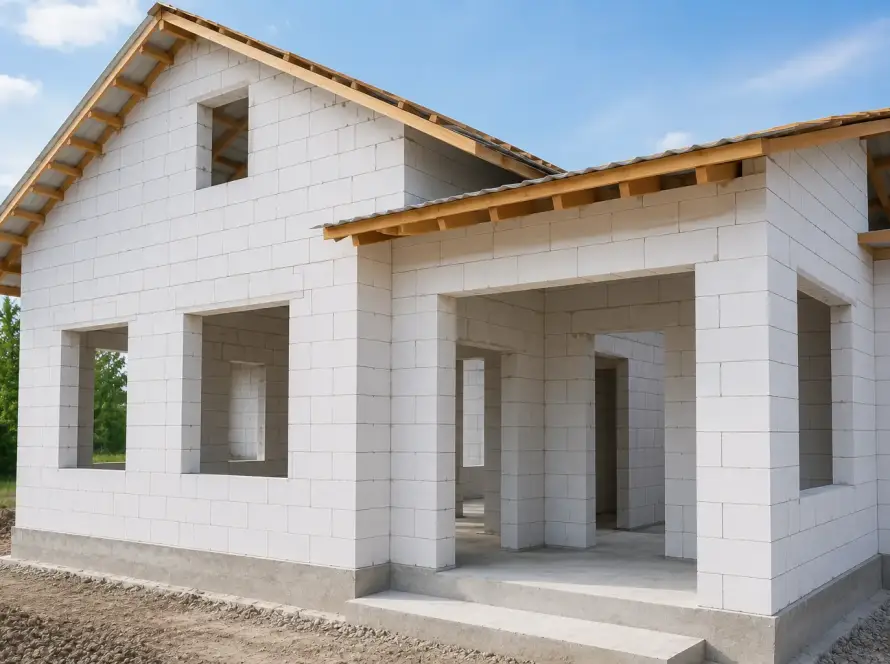
Planning to build a two-story house requires early preparation, including choosing the right building materials. Should you use lightweight bricks or red bricks?
Each has its own advantages and disadvantages. However, lightweight bricks are often recommended for two-story homes because the material’s strength can support the building’s structure.
But are lightweight bricks safe for long-term use in a two-story house? What is the proper way to install them to ensure the building is sturdy and strong?
Let’s find out more in the discussion below!
What Is Lightweight Brick?
Lightweight bricks are a wall material made from cement, silica sand, lime, water, and a foaming agent that creates numerous air pores within the material.
It is this porous structure that makes lightweight bricks significantly lighter than conventional bricks of the same size.
Lightweight bricks are generally manufactured using a controlled production process, resulting in relatively uniform dimensions and a smoother surface.
This dimensional precision is one of the reasons lightweight bricks are widely used for two-story homes, as it allows for neater wall construction with a thin layer of adhesive.
Just because it’s lightweight doesn’t mean this material isn’t strong. Lightweight bricks have the compressive strength required for wall applications.
However, it is important to understand that lightweight bricks are used as wall material, not as a substitute for primary structural elements such as columns, beams, and foundations.
Reasons for Building Houses with Lightweight Bricks
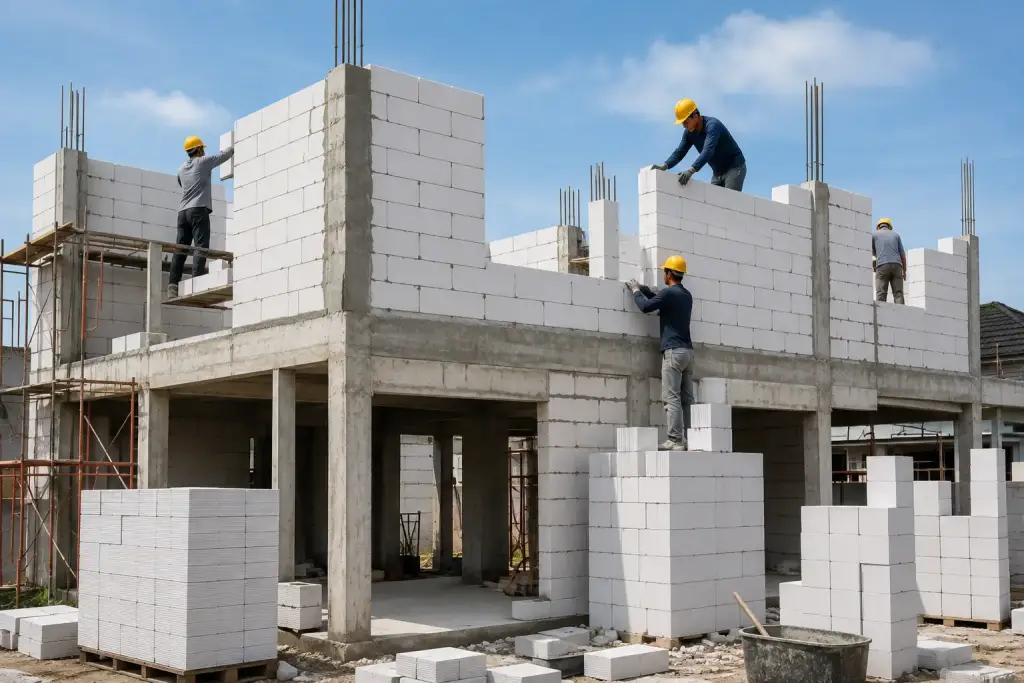
1. Lighter and Smoother Material
The lower weight of lightweight bricks helps reduce the dead load on the building structure. Their relatively smooth surfaces and precise dimensions also make the process of erecting walls easier.
For a two-story house, this feature can help carpenters work more efficiently.
2. Heat-Resistant, Good Insulator
The air pores in lightweight bricks help prevent heat transfer. Therefore, lightweight bricks have fairly good thermal insulation properties.
Walls can help keep the room temperature from being affected too quickly by heat from outside, especially when the house is exposed to intense sunlight.
3. Capable of Supporting the Building’s Heavy Load
Lightweight bricks have sufficient compressive strength to be used as wall material in buildings, including two-story houses, as long as the material specifications and installation methods are appropriate. However, the building’s main load must still be supported by a properly designed structural system.
4. More Cost-Effective
Because lightweight bricks are large, relatively fewer units are needed to cover a wall area.
Installation can also be faster and requires only a thin layer of adhesive. These savings in materials and labor time have the potential to help reduce construction costs.
5. Earthquake-Resistant
Lighter wall weights can be an advantage when a building is subjected to seismic shaking. A lower building mass means that the inertial forces caused by an earthquake on non-structural components will also be smaller.
However, earthquake resistance is still largely determined by the overall design and construction of the house.
6. Easier Finishing Applications
The smooth and precise surface of lightweight bricks makes finishing processes such as plastering, rendering, and the application of other coatings easier to perform. Neatly laid walls also help produce a smoother final finish.
7. Environmentally Friendly
The use of lighter materials and relatively efficient construction processes can help reduce material consumption and construction waste. Lightweight bricks also have characteristics that support more efficient construction compared to certain conventional wall materials.
8. Highly Resistant to Mold and Termites
Lightweight bricks are a mineral-based material, so they do not serve as a food source for termites, unlike wood-based materials.
This material is also resistant to decay. Even so, excess moisture in the building must still be controlled to prevent problems with the walls and finishes.
See Also: 8 Ways to Install Lightweight Bricks for a Neater, More Precise, and Sturdier Result
So, Are Lightweight Bricks Safe for a Two-Story House?
Lightweight bricks for two-story houses can generally be used safely, as long as the materials are selected, the structure is designed, and the installation is carried out correctly.
Lightweight bricks serve as infill walls, while the building’s main load must be supported by the foundation, columns, beams, and other structural elements.
Safety is also affected by the quality of the lightweight bricks and the adhesive used. Sloppy installation, joints that are too thick, walls that are not plumb, or the absence of ties in certain areas can actually cause the walls to crack easily.
So, don’t just look at the materials. Make sure the entire installation system for lightweight bricks in a two-story house follows proper construction practices.
The Benefits of Using Lightweight Bricks for a Two-Story House
1. Reducing the Load on a Two-Story Building
The lower weight of lightweight bricks helps reduce the load on the building’s structure. This is one of the key advantages of using this material in multi-story homes.
2. Helps Reduce Noise
The porous structure of lightweight bricks can help reduce sound transmission compared to some denser wall materials. With proper installation and finishing, these walls can help create a more comfortable living space.
3. Earthquake-Resistant
Lighter wall weights can help reduce a building’s non-structural mass. However, Milanians still need to ensure that the structure of their homes is designed in accordance with earthquake-resistant construction codes, since lightweight bricks alone do not determine a home’s earthquake resistance.
4. Neater and More Precise Walls
The uniform dimensions of lightweight bricks make it easier to build straight and even walls. As a result, the finishing work is more precise, and the walls have a neater appearance.
5. Easy to Cut and Install
Lightweight bricks are relatively easy to cut using the right tools. This makes it easier for builders to customize the material to fit the dimensions of door and window openings, building corners, and installation areas.
6. Suitable for Modern Home Designs
Their clean, sleek appearance and efficient construction process make lightweight bricks a popular choice in modern home construction. This material can also be easily combined with various types of finishes to achieve the desired interior and exterior looks.
See Also: Advantages and Disadvantages of Lightweight Bricks for Home Construction
The Ideal Thickness of Lightweight Bricks for a Two-Story House
The thickness of lightweight bricks for a two-story house cannot be determined based solely on the number of stories. The choice of thickness must take into account the wall’s function, installation location, strength requirements, insulation, and the specifications of the materials used.
For infill walls, lightweight bricks with a thickness of about 7.5–10 cm are commonly available on the market. However, the most appropriate size must still be determined based on the building design and the technical recommendations of the manufacturer or a professional.
Don’t choose lightweight bricks just because they’re cheaper. For a two-story house, material quality, density, compressive strength, dimensional consistency, and installation methods are far more important.
Things to Avoid When Building a Two-Story House with Lightweight Concrete Bricks
Although lightweight bricks are safe to use for two-story homes, Milanians should still exercise caution. Avoid the following when building a two-story home using lightweight bricks.
- Using lightweight bricks without considering the technical specifications
- Ignoring the structural design of a building
- Using the wrong adhesive
- Applying the adhesive layer too thickly
- Installing lightweight bricks on a dirty surface
- Failure to ensure that the walls are straight and level
- Ignoring the wall ties with the columns
- Failure to take into account the connections between the walls and the beams and slabs
- Do not apply any special treatment to areas prone to cracking
- Ignoring the moisture conditions of the materials and the work area
How to Install Lightweight Bricks So They Are Strong and Less Prone to Cracking for a Two-Story House
1. Make sure the house is structurally sound
Before installing lightweight bricks, make sure the foundation, columns, beams, and main structure of the house have been built according to the plans. Lightweight brick walls do not replace the main structural elements, so their installation must follow the building’s structural system.
2. Use high-quality, uniform lightweight bricks
Choose lightweight bricks with consistent quality and dimensions. Materials with too many defects, cracks, or inconsistent sizes can complicate the installation process and result in walls that are less than neat.
3. Clean the Surface of the Lightweight Bricks
The surface of the lightweight brick must be free of dust, dirt, or other materials that could interfere with adhesion. A clean surface helps the adhesive perform more effectively and results in a stronger bond.
4. Use a Special Adhesive for Lightweight Bricks to Bond the Materials
Use an adhesive specifically formulated for lightweight bricks, rather than relying solely on a standard cement mixture. A specialized adhesive allows for installation with a thin layer while helping to create a stronger bond between the bricks.
The adhesives that Milanians can use are Milan Lightweight Brick Adhesive Specially designed to bond Hebel materials with strong adhesion. It dries quickly—in just 5 minutes—and is suitable for construction use.
5. Start from the corner and keep it straight
Installation should begin at a corner as a reference point. Use string, a spirit level, or an appropriate measuring tool to ensure that each section remains straight, vertical, and level.
6. Apply the Adhesive According to the Instructions for Use
Mix and apply the adhesive according to the product instructions. Do not add water indiscriminately or make the mixture too thin, as this can affect the adhesive’s properties. Use the appropriate application tool to ensure a more consistent adhesive thickness.
7. Add a tie to the column
Special attention must be paid to the connection between lightweight brick walls and structural columns. Appropriate ties or connection details help keep the walls integrated with the structure and reduce the risk of excessive movement.
8. Pay attention to where the walls meet the beams and slabs
The areas where walls meet beams or slabs require special attention because they may experience different movements. Proper joint details help reduce the potential for cracks to form in these areas.
9. Use mesh in areas prone to cracking
Mesh can be used in specific areas prone to cracking, particularly at joints between different materials or around openings. It must be installed as needed and in accordance with proper construction methods.
Why Should You Use Milan Lightweight Brick Adhesive to Build a Two-Story House with Hebel?
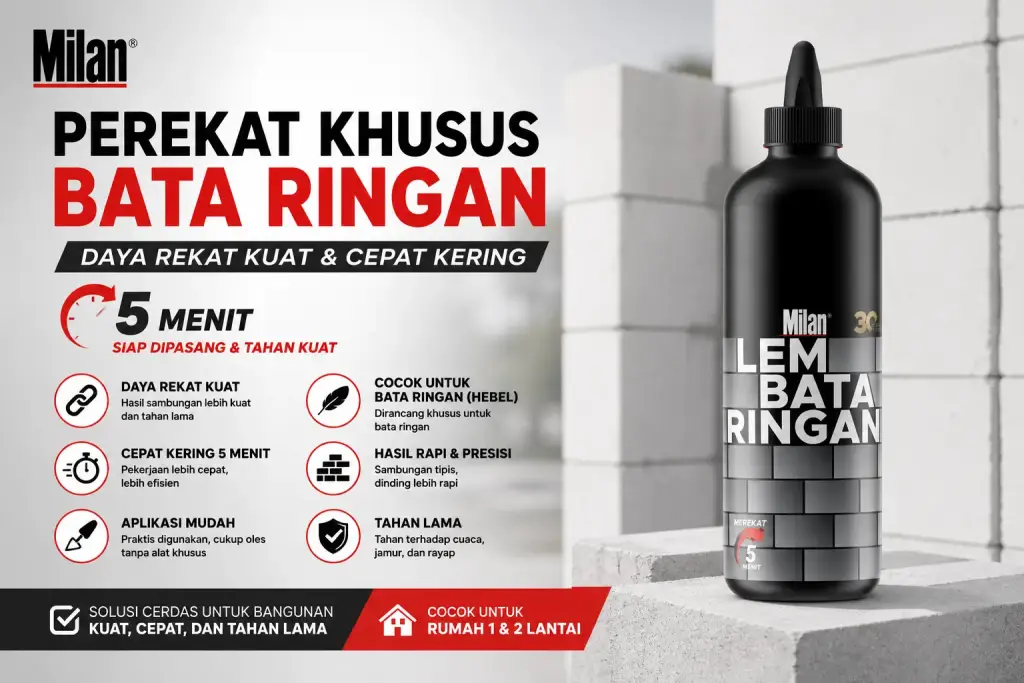
The choice of adhesive should not be taken lightly when Milanians use lightweight bricks for a two-story house. Neatly laid walls require an adhesive that is compatible with the characteristics of lightweight bricks so that the joints can function properly.
Milan Lightweight Brick Adhesive It is designed as a special adhesive to facilitate the installation of lightweight bricks. The use of this special adhesive also allows wall construction to be carried out using a more practical application system than conventional methods.
Some reasons to use Milan Lightweight Brick Adhesive include:
- Special adhesive for lightweight bricks
- Bonds in 5 minutes
- Water- and weather-resistant
- Helps create neater joints
- Supports thin-film applications
- Convenient for use by tradespeople and professional workers
- Helps speed up the installation process
- Suitable for lightweight brick wall construction projects
Use Milan Lightweight Brick Adhesive to Bond Hebel Blocks in a Two-Story House—Guaranteed to Be Strong and Sturdy!
Using lightweight bricks for a two-story house is the best choice. In addition to being strong, lightweight bricks also serve as good insulators, making them resistant to heat and fire.
In fact, lightweight bricks are also more resistant to seismic shocks, provided they are installed properly, including the application of adhesive.
Milan Lightweight Brick Adhesive This product is a ready-to-use, instant Hebel adhesive that dries quickly—in just 5 minutes. It offers strong adhesion and is water- and weather-resistant.
So, don’t hesitate. Lightweight bricks for a two-story house are safe, as long as they’re bonded with Milan Lightweight Brick Adhesive.
Curious about the proper use of Milan Lightweight Brick Adhesive for your home project?
Discuss your needs with Milan’s team of experts by clicking the banner below!