Pernah melihat furniture dengan permukaan bermotif kayu, warna solid, atau tekstur tertentu yang terlihat rapi dan seragam? Bisa jadi, permukaannya menggunakan laminasi HPL yang kerap ditemukan pada meja, kabinet, lemari, hingga kitchen set.
Tapi, sebenarnya apa itu laminasi HPL dan kenapa sering digunakan pada furniture? Singkatnya, laminasi High Pressure Laminate (HPL) adalah proses menempelkan lembaran HPL) pada permukaan material seperti plywood, MDF, particle board, atau papan olahan kayu lainnya.
HPL bukan hanya membuat furniture terlihat lebih menarik, tetapi juga membantu melindungi permukaan dan membuatnya lebih mudah dirawat.
Supaya hasilnya rapi dan tahan lama, proses laminasi HPL tidak bisa dilakukan asal tempel. Pemilihan substrat, kondisi permukaan, jenis perekat, hingga teknik pemasangan semuanya ikut menentukan kualitas hasil akhirnya.
Apa Itu Laminasi HPL dan Bagaimana Karakteristiknya?
Apa itu laminasi HPL? Laminasi HPL merupakan proses pelapisan permukaan furniture menggunakan lembaran High Pressure Laminate sebagai lapisan dekoratif sekaligus pelindung. HPL diproduksi melalui proses pengepresan beberapa lapisan material berbasis kertas yang telah diberi resin pada tekanan dan suhu tinggi.
HPL memiliki karakteristik permukaan yang relatif keras, tersedia dalam banyak warna, motif, dan tekstur. Karena pilihan desainnya beragam, material ini dapat digunakan untuk menciptakan tampilan furniture bergaya minimalis, modern, industrial, klasik, maupun natural.
Dalam aplikasi furniture, HPL umumnya ditempelkan pada papan seperti plywood, MDF, particle board, atau material sejenis. Hasil akhirnya sangat dipengaruhi oleh kualitas permukaan substrat dan perekat yang digunakan.
HPL juga dikenal praktis dalam perawatan. Permukaannya cukup mudah dibersihkan dari debu dan kotoran sehari-hari. Namun, HPL tetap perlu diaplikasikan dengan teknik yang tepat karena bagian tepi dan sambungan merupakan area yang cukup rentan mengalami pengangkatan jika proses perekatan kurang optimal.
See Also: Understanding HPL Adhesive: A Strong Bonding Solution for Premium Interior Furniture
Proses Pembuatan Laminasi HPL
Proses pembuatan HPL dimulai dari penyusunan beberapa lapisan kertas yang telah diberi resin. Setiap lapisan memiliki fungsi berbeda untuk membentuk struktur, tampilan, serta ketahanan HPL.
Lapisan tersebut kemudian disusun dan diproses menggunakan tekanan serta temperatur tinggi. Proses pengepresan membuat lapisan-lapisan tersebut menyatu menjadi lembaran laminasi yang padat dan stabil.
Setelah lembaran terbentuk, permukaannya dapat diberikan tekstur tertentu sesuai desain yang diinginkan. Produsen kemudian membuat berbagai motif, mulai dari warna solid, motif kayu, batu, marmer, hingga pola dekoratif lainnya.
Dalam penerapannya pada furniture, lembaran HPL yang sudah jadi kemudian dipotong sesuai kebutuhan dan direkatkan pada permukaan substrat. Pada tahap inilah pemilihan lem laminasi HPL menjadi penting karena perekat harus mampu menghasilkan ikatan yang kuat dan merata.
Komposisi pada Material Laminasi HPL
1. Kraft Paper
Kraft paper menjadi bagian dasar dalam struktur HPL karena berfungsi membentuk lapisan inti sekaligus memberikan ketebalan dan kekuatan pada lembaran laminasi.
Beberapa lapisan kraft paper biasanya disusun dan diberi resin sebelum diproses dengan tekanan serta suhu tinggi.
Semakin baik struktur lapisan ini, semakin stabil pula lembaran HPL ketika digunakan sebagai material finishing furniture.
Kraft paper juga berperan dalam memberikan karakter kuat pada HPL sehingga dapat digunakan untuk berbagai kebutuhan interior.
2. Decorative Paper
Decorative paper merupakan lapisan yang menentukan tampilan visual HPL. Lapisan ini dapat memiliki warna, pola, atau motif tertentu, misalnya motif serat kayu, marmer, beton, maupun warna solid.
Dalam industri furniture, decorative paper menjadi salah satu bagian penting karena memberikan pilihan desain yang sangat luas. Milanians dapat menyesuaikan motif HPL dengan konsep ruangan dan gaya furniture yang dibuat.
3. Overlay Paper
Overlay paper merupakan lapisan pelindung yang berada di bagian paling atas pada jenis HPL tertentu. Lapisan ini membantu melindungi pola dekoratif di bawahnya dari gesekan dan penggunaan sehari-hari.
Keberadaan overlay juga membantu mempertahankan tampilan permukaan HPL agar tetap terlihat baik selama masa pemakaian. Karakteristik perlindungannya dapat berbeda tergantung jenis dan spesifikasi HPL yang digunakan.
See Also: Causes of HPL Laminate Bubbling After Installation
Fungsi Laminasi HPL dalam Industri Furniture
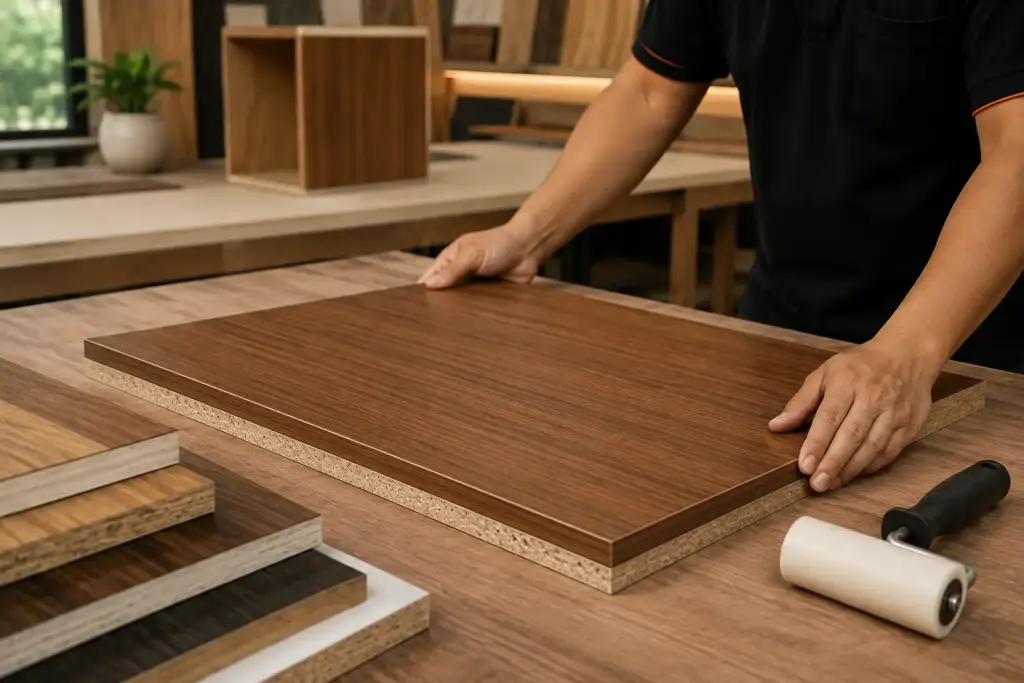
1. Melindungi Permukaan dari Goresan
Salah satu fungsi laminasi HPL adalah memberikan lapisan tambahan pada permukaan furniture. HPL membantu mengurangi dampak penggunaan sehari-hari seperti gesekan ringan, sehingga permukaan substrat di bawahnya tidak langsung terpapar.
2. Sebagai Finishing Furniture agar Semakin Estetik
HPL memberikan banyak pilihan warna, motif, dan tekstur. Karena itu, material ini dapat digunakan untuk meningkatkan tampilan meja, kabinet, kitchen set, lemari, rak, dan berbagai produk furniture lainnya.
3. Meningkatkan Daya Tahan Furniture
Laminasi HPL memberikan lapisan tambahan pada furniture sehingga permukaan material menjadi lebih terlindungi dari penggunaan sehari-hari. Namun, daya tahan keseluruhan tetap bergantung pada kualitas substrat, HPL, perekat, serta teknik aplikasinya.
4. Perawatan Menjadi Lebih Mudah
Permukaan HPL relatif praktis untuk dibersihkan. Debu dan kotoran ringan umumnya dapat dibersihkan menggunakan kain yang sesuai, sehingga furniture tidak membutuhkan perawatan finishing yang terlalu rumit.
5. Meningkatkan Nilai Jual Furniture
Furniture dengan finishing HPL dapat memiliki tampilan yang lebih rapi dan menarik. Banyaknya pilihan motif juga memungkinkan produsen menghasilkan produk dengan tampilan premium tanpa harus menggunakan material finishing dengan proses yang jauh lebih kompleks.
Kelebihan dan Kekurangan Laminasi HPL pada Produk Furniture
| Aspect | Advantages | Disadvantages |
| Appearance | Tersedia banyak warna, motif, dan tekstur | Motif tertentu dapat terlihat kurang natural dibandingkan material finishing yang menggunakan veneer kayu asli. |
| Ketahanan permukaan | Permukaan HPL relatif kuat untuk dan membantu melindungi substrat. | Tetap dapat rusak atau tergores jika terkena benturan, gesekan berat, atau penggunaan yang tidak sesuai. |
| Maintenance | Relatif mudah dibersihkan dan tidak membutuhkan perawatan yang rumit. | Kotoran atau cairan yang masuk melalui bagian sambungan dapat menjadi masalah jika pemasangan tepi tidak rapat. |
| Proses aplikasi | Dapat diaplikasikan pada berbagai papan olahan kayu dengan perekat yang sesuai. | Membutuhkan permukaan yang rata, bersih, serta teknik pemasangan yang tepat. |
| Harga | Menawarkan tampilan dekoratif dengan pilihan desain yang luas. | Biaya material dan pemasangan tetap bergantung pada jenis HPL, substrat, serta kualitas pekerjaan. |
| Perbaikan | Kerusakan pada satu bagian dapat ditangani sesuai kondisi furniture. | HPL yang sudah rusak atau terkelupas pada area tertentu tidak selalu mudah diperbaiki tanpa terlihat bekasnya. |
Perbedaan HPL dengan Material Finishing Furniture Lainnya
| Finishing Materials | Characteristics | Advantages | Disadvantages |
| HPL | Lembaran laminasi dekoratif yang ditempel pada substrat. | Motif beragam, praktis, relatif mudah dirawat, dan cocok untuk berbagai furniture. | Memerlukan perekat dan teknik pemasangan yang tepat, terutama pada bagian tepi. |
| Veneer | Lapisan tipis dari kayu asli. | Memberikan tampilan dan karakter serat kayu yang lebih natural. | Perawatan dan proses finishing dapat lebih kompleks. |
| Melamine | Lapisan finishing berbasis resin yang sudah terintegrasi dengan papan. | Praktis dan tersedia dalam berbagai desain. | Pilihan dan karakter aplikasinya berbeda dengan HPL serta tidak selalu cocok untuk kebutuhan yang sama. |
| PVC Sheet | Lembaran sintetis yang digunakan sebagai pelapis permukaan. | Fleksibel untuk kebutuhan dekoratif tertentu dan memiliki banyak pilihan desain. | Karakter ketahanan dan aplikasinya bergantung pada jenis produk serta perekat yang digunakan. |
Tips agar Laminasi HPL Merekat Sempurna pada Furniture
1. Pastikan Permukaan Substrat Sudah Bersih dan Rata
Sebelum memasang HPL, pastikan permukaan plywood, MDF, atau substrat lainnya benar-benar rata dan bersih. Debu, minyak, kotoran, silikon, sisa lem, maupun lapisan lain dapat mengganggu kontak antara perekat dan permukaan.
Permukaan yang tidak rata juga dapat menyebabkan HPL tidak menempel sempurna. Karena itu, periksa seluruh area sebelum proses laminasi dimulai.
2. Amplas Permukaan Sampai Halus
Jika permukaan substrat masih memiliki bagian kasar atau tidak rata, lakukan pengamplasan terlebih dahulu.
Tujuannya bukan hanya membuat permukaan terlihat halus, tetapi juga membantu mempersiapkan substrat agar proses perekatan berlangsung lebih optimal.
Setelah diamplas, bersihkan kembali debu hasil pengamplasan sebelum perekat diaplikasikan.
3. Aplikasikan Lem Khusus HPL sesuai Petunjuk
Gunakan lem laminasi HPL yang memang dirancang untuk merekatkan HPL dengan substrat yang digunakan. Aplikasikan secara merata dan ikuti petunjuk penggunaan produk, termasuk jumlah aplikasi, cara penyatuan permukaan, serta waktu yang diperlukan.
Untuk kebutuhan laminasi furniture, Milanians bisa menggunakan Milan HPL Adhesive sebagai perekat waterbase yang dirancang khusus untuk laminasi HPL dan PVC sheet. Keunggulan utamanya ialah bisa aplikasi satu sisi dan dapat langsung ditempel tanpa perlu menunggu proses flash off.
4. Pasang Laminasi HPL dan Tekan Hati-hati Menggunakan Roller
Setelah perekat diaplikasikan sesuai petunjuk, posisikan lembaran HPL dengan hati-hati agar tidak bergeser. Lakukan penekanan secara merata menggunakan roller atau alat yang sesuai.
Tekanan yang merata membantu memastikan permukaan HPL benar-benar berkontak dengan substrat dan mengurangi risiko terbentuknya area yang tidak merekat.
5. Perhatikan Bagian Tepi, Pastikan Sudah Merekat dan Tidak Terangkat
Bagian tepi HPL perlu diperiksa secara menyeluruh setelah pemasangan. Pastikan tidak ada bagian yang menggelembung, terbuka, atau terangkat.
Area tepi yang tidak mendapatkan tekanan atau perekat secara optimal dapat menjadi titik awal HPL terkelupas. Jasi, berikan perhatian ekstra pada sudut, sambungan, dan bagian pinggir furniture.
See Also: 7 Ways to Use HPL Adhesive for a Neater and Stronger Finish
Keunggulan Lem HPL Milan untuk Laminasi HPL pada Furniture
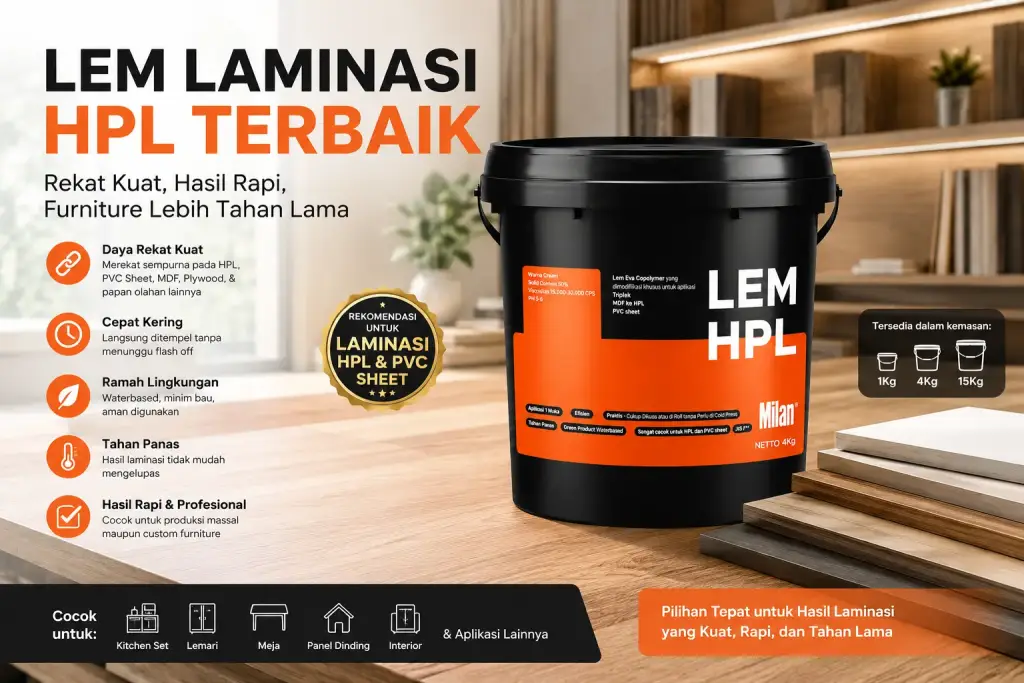
Pemilihan perekat sangat menentukan keberhasilan proses laminasi HPL. Jadi, pastikan Milanians tidak asal dalam menggunakan perekat.
Solusi yang paling tepat untuk kebutuhan laminasi HPL adalah Milan HPL Adhesive. Alasannya sederhana, karena produk ini memang hadir khusus untuk merekatkan laminasi HPL dan PVC sheet pada berbagai aplikasi interior, termasuk furniture, meja, dan panel dekoratif. Formulanya berbasis waterbase sehingga proses aplikasi lebih praktis dan bersih.
Beberapa keunggulan yang ditawarkan antara lain:
- Aplikasi satu sisi
- Bisa langsung ditempel
- Quick-drying
- Minim bau menyengat
- Environmentally friendly
- Tahan panas
- Cocok untuk plywood, MDF, dan papan olahan kayu sejenis
- Tersedia dalam kemasan 1 kg, 4 kg, dan 15 kg
FAQ (Frequently Asked Questions)
Apakah Laminasi HPL Aman dan Tahan Lama untuk Furniture?
Ya, HPL banyak digunakan sebagai finishing furniture karena memiliki permukaan yang relatif kuat dan praktis untuk penggunaan sehari-hari. Ketahanannya tetap dipengaruhi oleh kualitas HPL, substrat, perekat, teknik pemasangan, dan kondisi penggunaan.
Berapa Lama Laminasi HPL Dapat Bertahan pada Furniture?
Tidak ada satu angka pasti karena umur pakai dipengaruhi oleh kualitas material, kondisi lingkungan, intensitas penggunaan, dan kualitas pemasangan. Laminasi yang dipasang pada permukaan yang tepat dengan perekat dan teknik yang benar cenderung lebih awet.
Furniture Apa Saja yang Cocok Menggunakan Laminasi HPL?
HPL cocok digunakan pada berbagai furniture seperti meja, kabinet, lemari, rak, kitchen set, meja kerja, dan panel interior. Pemilihan jenis HPL sebaiknya disesuaikan dengan fungsi serta kondisi penggunaan furniture.
Apa Faktor Penting dalam Memilih Perekat Laminasi HPL?
Perhatikan kesesuaian perekat dengan HPL dan substrat, daya rekat, metode aplikasi, waktu pengeringan, serta kondisi lingkungan saat pengerjaan. Perekat juga harus diaplikasikan sesuai petunjuk agar hasil laminasi tidak mudah terangkat.
Apa Saja Jenis Finishing Laminasi HPL untuk Furniture?
HPL tersedia dalam berbagai pilihan finishing permukaan, seperti matte, glossy, tekstur kayu, tekstur batu, warna solid, hingga berbagai pola dekoratif. Pilihannya dapat disesuaikan dengan konsep desain dan kebutuhan furniture.
Tingkatkan Daya Rekat Laminasi HPL pada Furniture dengan Lem Khusus dari Milan!
Memahami apa itu laminasi HPL untuk furniture memang penting buat woodworking profesional. Namun, agar laminasi HPL merekat sempurna pada papan material furniture juga harus dipikirkan sedari awal.
Salah pilih perekat, bisa berpengaruh pada hasil akhir – mudah lepas dan laminasi HPL menggelembung. Dari sinilah, PT Indocipta Wisesa menghadirkan solusi perekat laminasi HPL lewat produk inovasinya bernama Milan HPL Adhesive.
Milan HPL Adhesive hadir untuk merekatkan laminasi HPL pada berbagai material substrat, seperti plywood, MDF, dan papan olahan kayu sejenis. Daya rekatnya kuat, cepat kering, dan tahan panas.
Tertarik menggunakan Lem HPL Milan untuk proyek furniture Milanians?
Segera hubungi Tim Ahli Milan dengan klik banner di bawah ini!