Don’t want your walls to crack easily after installation? Then Milanians need to understand that the type of adhesive used must be suitable for the job. The options aren’t limited to cement mortar—there’s also Milan’s instant adhesive for lightweight bricks, which can be confusing.
Mortar has long been used in construction projects because many builders are familiar with its application. On the other hand, lightweight brick adhesive offers a more practical bonding solution and is specifically designed for installing building materials.
So, is automatic lightweight brick adhesive stronger? Or is cement mortar actually superior? Let’s take a look at the differences between cement mortar and Milan Lightweight Brick Adhesive—from their functions to how they’re applied.
What Is Cement Mortar?
Cement mortar is a cement-based mixture commonly used as a binding agent in construction work. When building walls, conventional mortar typically consists of cement, sand, and water in specific proportions.
This mixture is used to fill and seal gaps between materials such as red bricks, concrete blocks, and lightweight bricks.
Because it must be mixed before use, the consistency of the mortar depends heavily on the proportions of the ingredients and the mixing process. If the mixture contains too much water or is not homogeneous, the quality of the bond may be compromised.
Mortar also tends to produce a thicker adhesive layer compared to special adhesive for lightweight bricks. This thickness can help accommodate uneven material surfaces, but it results in greater material usage.
What Is Milan Lightweight Brick Adhesive?
Milan Lightweight Brick Adhesive is a ready-to-use, instant construction adhesive designed to provide strong bonding strength for the installation of lightweight bricks and other masonry materials.
This product has a single-component formulation, so it does not require mixing with any additional ingredients before use.
One of its key features is its fast drying time—only about 5 minutes. When applied correctly, the adhesive can help speed up wall installation compared to methods that require mixing mortar first.
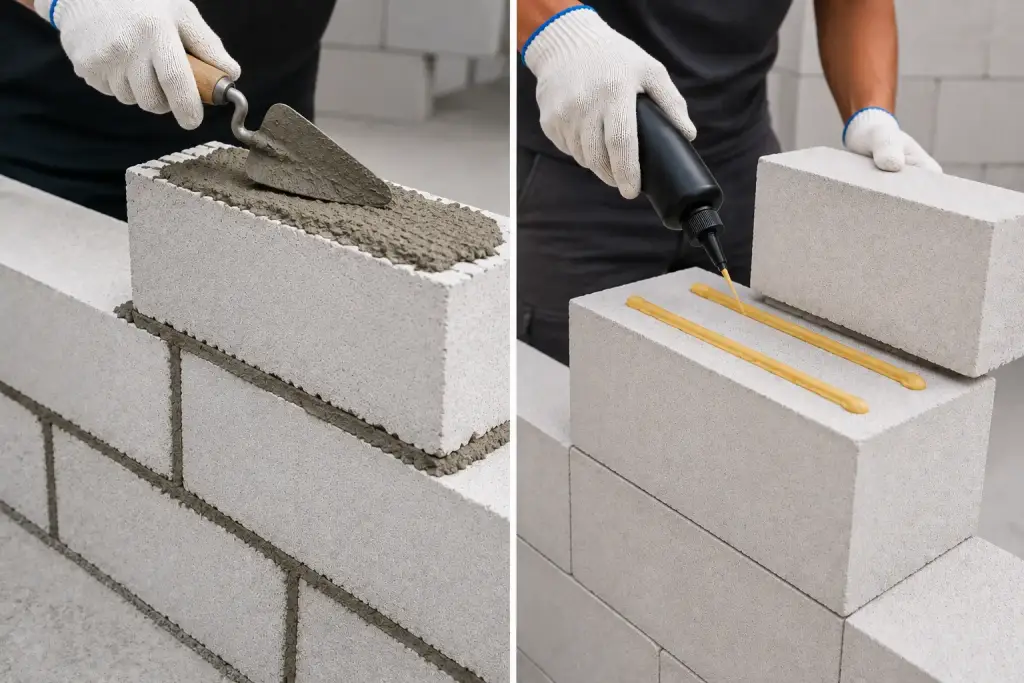
In addition, Milan Lightweight Brick Adhesive can also be used on lightweight bricks, natural stone, clay bricks, and several other stone materials. It’s easy to apply—simply apply two lengthwise lines to the surface of the brick to securely bond the materials.
The Difference Between Cement Mortar and Milan Lightweight Brick Adhesive
1. Main Functions
Mortar serves as both a binding agent and a filler for gaps between materials. Because it consists of a mixture of cement and aggregate, mortar can be used in various masonry and construction projects, such as wall plastering, wall rendering, brick bonding, and tile bonding.
Meanwhile, Milan Lightweight Brick Adhesive is primarily designed as an adhesive for conveniently bonding materials. Its adhesive properties allow for more controlled application without the need to mix cement and sand beforehand.
2. Ingredients or Formulas Used
Conventional mortar requires cement, sand, and water to be mixed together before application. The final quality is greatly influenced by the composition and consistency of the mixture.
Milan Lightweight Brick Adhesive uses a ready-to-use, single-component adhesive formulation. This means that Milanians don’t need to mix in any additional ingredients before applying it.
3. Applications of Materials and Their Thicknesses
Mortar is generally applied in relatively thicker layers to help fill gaps or unevenness in the brick surface. This requires a greater volume of material.
Lightweight brick adhesive can be applied as a line of adhesive on the surface of the brick. Milan recommends applying two longitudinal lines before attaching the next brick.
4. Final Installation Results
The difference between cement mortar and Milan lightweight brick adhesive is also evident in the final result of the installation. Using mortar can produce thicker joints, allowing for more flexibility when leveling the bricks.
Meanwhile, lightweight brick mortar helps create thinner, neater joints. If the brick surfaces are level and the installation technique is correct, the finished masonry will look more precise while also reducing the amount of mortar used.
5. Advantages
The advantages of mortar lie in the fact that many builders are already familiar with its use, as well as its flexibility in construction work.
Meanwhile, the advantages of cement mortar over Milan lightweight brick adhesive are evident in terms of practicality. Milan lightweight brick adhesive is ready to use, dries quickly, is cost-effective, is water- and weather-resistant, and has strong adhesive strength. A 0.5 kg package is also claimed to cover approximately 15–18 m², depending on application conditions.
See Also: 8 Ways to Install Lightweight Bricks for a Neater, More Precise, and Sturdier Result
Which Is Better Suited as an Adhesive for Interior and Exterior Walls?
For installing lightweight bricks on interior or exterior walls, lightweight brick adhesive can be a practical choice since it is specifically designed as a construction adhesive.
Milan Lightweight Brick Adhesive is water- and weather-resistant, making it suitable for construction needs in a variety of environmental conditions.
However, the choice of adhesive must still take the project conditions into account. The type of brick, surface conditions, installation techniques, environmental exposure, and product usage instructions must all be considered.
So, don’t just look at the “stronger” label—see how the adhesive is used in practice.
How Does the Type of Adhesive Affect the Strength of Lightweight Brick Walls?
Adhesives play a crucial role in forming bonds between bricks. The better the contact between the adhesive and the material’s surface, the more optimal the load transfer at the joint.
However, the strength of a wall is not determined solely by the type of adhesive. Even walls built with high-quality adhesive can still have problems if the brick surface is dirty, the bricks are laid unevenly, or the bricks are shifted before the adhesive dries.
In practice, Milan lightweight brick adhesive provides strong bonding when applied according to the instructions. The brick surface must be clean; the adhesive must be applied correctly; and the bricks must be set and pressed firmly into place immediately.
Does a Thicker Layer of Adhesive Mean a Stronger Wall?
Not necessarily.
The thickness of the adhesive is not the only indicator of the joint’s strength. A layer that is too thick can actually increase material usage and make the installation process less efficient.
What’s more important is the quality of the bond between the adhesive and the material. With lightweight brick adhesive, applying it as recommended helps ensure effective distribution of the adhesive without creating an excessive layer of adhesive.
See Also: 8 Mistakes When Installing Lightweight Bricks That Cause Walls to Crack Easily
Factors That Determine Adhesion Strength on Walls
1. Condition of the Wall Surface
The brick surface must be free of dust, oil, moss, and dirt. A dirty surface can reduce direct contact between the adhesive and the material.
2. Types of Wall Materials Used
Lightweight bricks, red bricks, concrete blocks, and other masonry materials each have different characteristics. Therefore, use an adhesive that is suitable for the material and the specific application.
3. Installation Techniques
The method of applying the adhesive greatly determines the final result. With Milan Lightweight Brick Adhesive, the adhesive is applied in two longitudinal lines, after which the bricks are immediately set in place and tamped down using a rubber mallet.
4. Types and Quality of Adhesives
A high-quality adhesive with the right formulation will help produce a stronger bond. Don’t just choose based on low price; consider its function, adhesive strength, and application instructions.
5. Temperature and Humidity of the Application Environment
Environmental conditions can affect the drying and curing processes of adhesives. Therefore, application should be carried out with due consideration of on-site conditions and the product’s instructions for use.
6. Drying Time
Brick that is moved or loaded before the adhesive has dried sufficiently can interfere with bond formation. Milan Lightweight Brick Adhesive has a drying time of about 5 minutes, but the application process must still follow the product instructions.
So, Which Is Stronger for Walls: Cement Mortar vs. Milan Lightweight Brick Adhesive?
If the question is which is stronger—cement mortar or Milan lightweight brick adhesive—the answer cannot be determined based solely on the type of adhesive.
The strength of a joint is greatly influenced by product quality, material condition, and installation techniques.
For installing lightweight bricks, Milan Lightweight Brick Adhesive offers strong adhesion with a more practical and faster application system.
The mixture is ready to use, so contractors don’t need to measure out the cement, sand, and water beforehand. The simpler application process can also help increase productivity.
So, for Milanians who prioritize efficiency, clean joints, economical use of materials, and a quick installation process, Milan Lightweight Brick Adhesive can be a more practical alternative to conventional mortar.
The Advantages of Milan Lightweight Brick Adhesive for Wall Installation
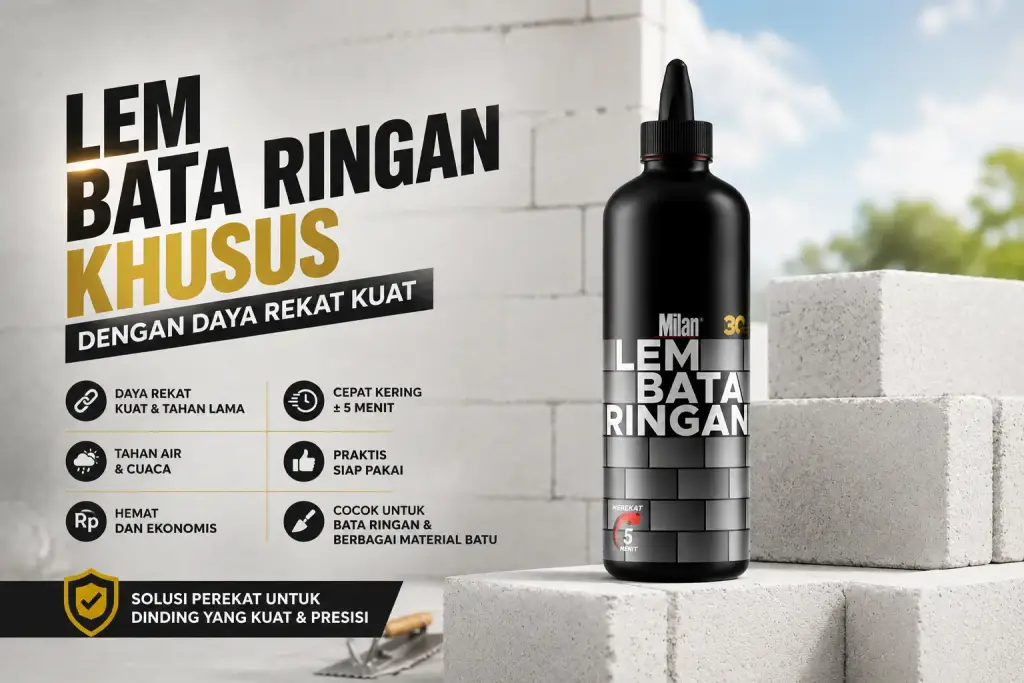
PT Indocipta Wisesa through its brand – Milan Offering a special lightweight brick adhesive that provides a variety of benefits.
With over 30 years of experience, Milan is able to address the various issues and challenges faced by the public when installing lightweight bricks on walls.
Here's why Milan Lightweight Brick Adhesive Here to support the ease and efficiency of Milanians’ construction projects.
The product is available in 500-gram and 800-gram bottles, making it easier for Milanians to use it for projects of various scales.
The advantages of Milan Lightweight Brick Adhesive for wall installation include:
- Dries quickly and sets in about 5 minutes
- Ready-to-use single-component formulation
- Strong and long-lasting adhesion
- Cost-effective and economical
- Water- and weather-resistant
- Improving Work Productivity
- Suitable for lightweight bricks and various stone materials
- A practical application with two elongated lines
- It does not require a mixing process like conventional mortar
- 0.5 kg package with coverage of approximately 15–18 m² and 0.8 kg package with coverage of 24–28 m², depending on application conditions
Use Milan Lightweight Brick Adhesive for Strong Bonding When Building Walls!
Understanding the difference between cement mortar and Milan Lightweight Brick Adhesive helps Milanians choose the right adhesive for their wall-building projects.
However, if Milanians want an adhesive that dries quickly, is easy to apply, and is economical—and offers strong adhesion—then Milan Lightweight Brick Adhesive The solution!
Setting in just 5 minutes, Milan Lightweight Brick Adhesive is the best choice for Milanians who want their projects completed quickly with maximum results.
There’s no need to hesitate—this product is manufactured by PT Indocipta Wisesa, a company with 30 years of experience in adhesive solutions.
Interested in using Milan Lightweight Brick Adhesive? Consult with Milan’s team of experts about your Milanians wall installation project by clicking the banner below!