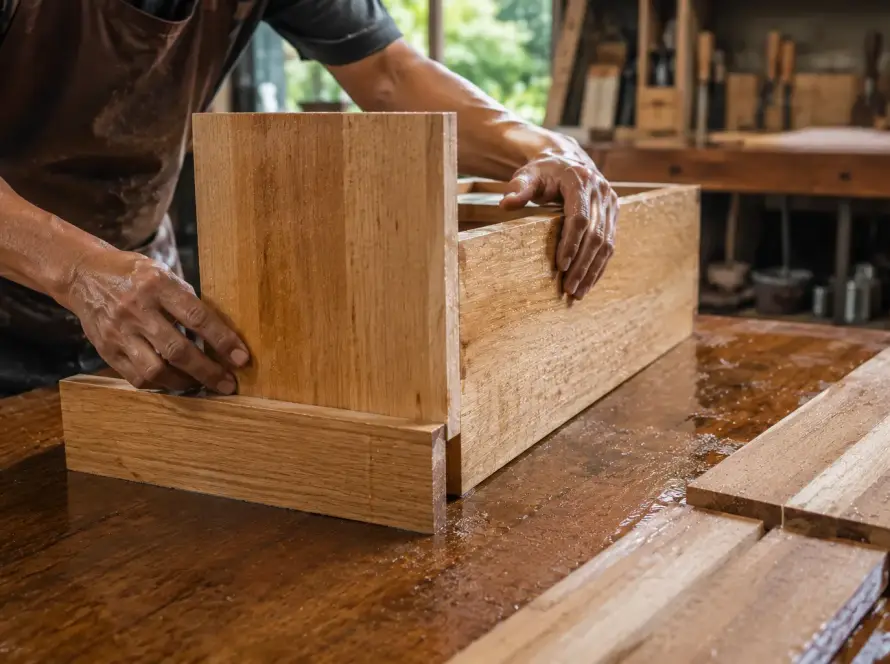
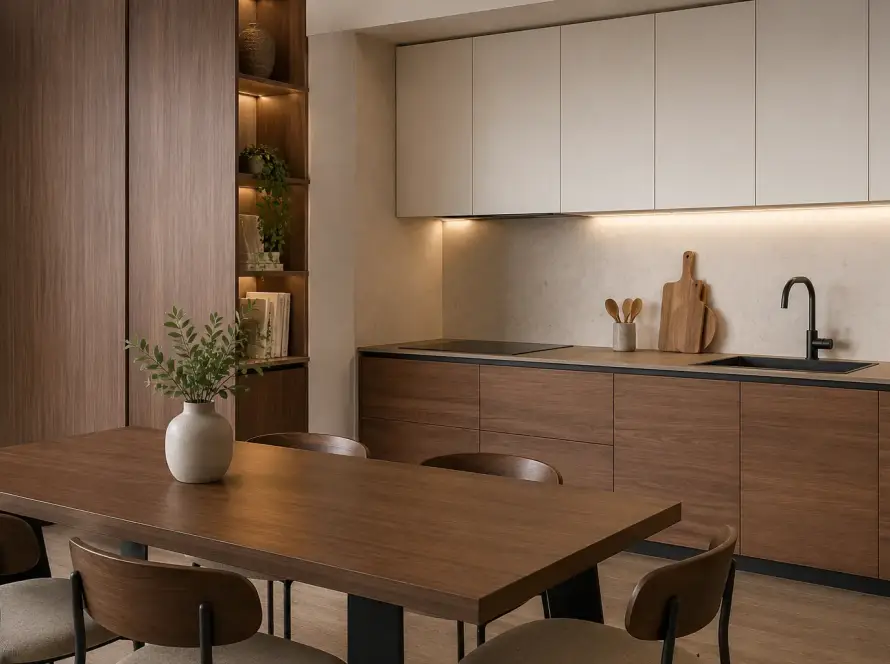
MDF and plywood are often the materials of choice for making furniture, whether on a large or small scale. However, many craftsmen focus only on the final product and do not pay attention to the manufacturing process from the beginning, including the application of adhesives.
Adhesives are essential for ensuring that joints between materials bond securely and do not come apart easily. Choosing the wrong adhesive can cause furniture parts to become loose, shift, or even come apart after use.
These two materials have different properties, so the choice of wood glue for MDF and plywood must also be tailored to specific needs.
Understanding the Characteristics of MDF and Plywood
Medium Density Fiberboard (MDF) is made from wood fibers compressed together with a binder. The material has a relatively homogeneous structure and a smooth surface, making it widely used for cabinets, shelves, tables, decorative panels, and furniture with a painted finish.
Meanwhile, plywood consists of several layers of wood veneer glued together with the grain running in different directions. This construction provides good strength and stability, making plywood widely used in the construction of furniture, cabinets, tables, wardrobes, and various interior applications.
Some characteristics to keep in mind:
- MDF: smooth, uniform surface; the edges are more porous.
- Multiplex: consists of a veneer layer; it is strong and relatively stable.
- MDF: easy to shape and suitable for interior furniture.
- Multiplex: suitable for furniture construction that requires structural strength.
Therefore, it’s very important to know which wood glue to use for MDF and plywood so that the joints don’t come apart or shift easily.
Why Do MDF and Plywood Require the Right Type of Adhesive?
MDF has a dense fiber structure, but its edges absorb glue quite readily. If the glue is absorbed too quickly or does not bond well, the joint may lose strength.
Plywood has distinct characteristics because it consists of layers of veneer. Its surface can vary, especially along the edges. Therefore, wood glue for MDF and plywood must be able to form an even bond and maintain the strength of the joint even after the furniture has been used.
The selection of wood adhesives for MDF and plywood is becoming increasingly important for joints that are subjected to loads, vibrations, and changes in humidity, or that are used in large-scale furniture production.
Can Wood Glue Be Used on MDF and Plywood?
Yes, it can. However, not all wood glues perform the same.
For lightweight interior furniture with tight joints, conventional wood glue can be used.
Meanwhile, for production needs that require stronger adhesion, moisture resistance, or the ability to bond multiple types of materials at once, Milanians may want to consider polyurethane or epoxy adhesives.
This means that when choosing wood glue for MDF and plywood, you should base your decision on the specific application rather than simply on the type of material.
Types of Wood Glue for MDF and Plywood
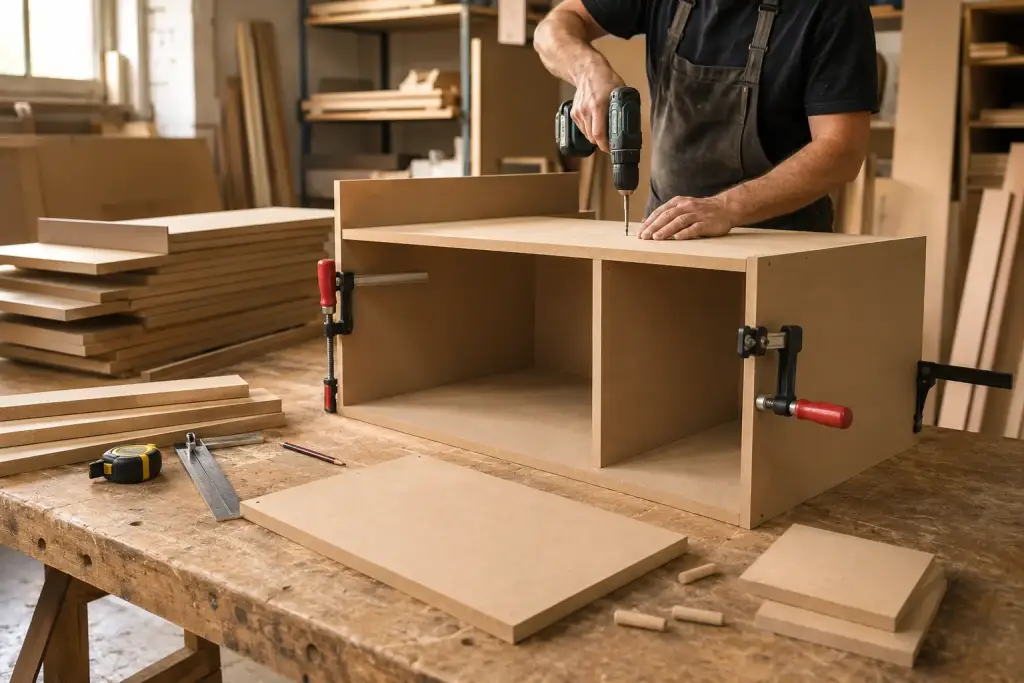
1. PVAc Glue
PVAc is a type of adhesive commonly used in woodworking and furniture making. This adhesive is ideal for bonding MDF and plywood, especially in interior furniture located in relatively dry environments.
PVAc is suitable for projects such as shelves, cabinets, panels, or simple joints that have smooth surfaces and can be clamped securely during the drying process.
2. Polyurethane (PU) Adhesive
Polyurethane adhesive, or PU adhesive, for wood has high bonding strength and can be used on a variety of substrates. This type of adhesive is attractive for furniture production because it can handle more demanding joint requirements than those found in light woodworking.
The available recommendations are Milan PU Adhesive 805 which can be used on wood, MDF, plywood, WPC, aluminum, and even PVC.
The main advantages of PU 805 are that it dries in about 2–5 minutes and is waterproof, making it suitable for both interior and exterior applications.
3. Epoxy Adhesive
Epoxy adhesives use a system of resin and hardener that are mixed together before application. Once the mixture has cured, it forms a strong bond and is ideal for joints that require high strength or involve different materials.
Milanians can use Milan Epoxy Adhesive which has extra-strong adhesive strength and can be used on wood, aluminum, iron, glass, ceramic, rubber, Formica, and other materials. This adhesive is also water-resistant and can be used to help fill gaps or voids in joints.
See Also: Is Epoxy Glue Suitable for Wood? Here Are Its Pros and Cons
The Differences Between MDF and Plywood in Furniture Production
| Aspect | MDF | Multiplex |
| Structure | Compressed wood fiber | Cross-grained wood veneer layer |
| Surface | Very smooth and uniform | Features a veneer grain pattern |
| Strength | Suitable for interior panels and furniture | Better for parts that require a strong structure |
| Processing | Easy to shape and profile | Suitable for cabinet and furniture construction |
| Edge | More porous | The veneer layer is visible |
| Finishing | Perfect for paint | Suitable for HPL, veneer, coating, or natural finish |
| Glue requirements | Good penetration and adhesion are required | A stable bond is needed on the wood surface |
Adhesive for MDF vs. Plywood—Are They the Same?
For some projects, the same product can be used as both MDF adhesive and plywood adhesive, as long as the adhesive’s specifications support both materials.
The differences lie mainly in the application techniques. The edges of MDF tend to be more absorbent, so the adhesive must be applied evenly. With plywood, Milanians need to ensure that the veneer layer at the joints is not peeling and that the surface is smooth.
For production that uses both MDF and plywood, multi-substrate adhesives such as polyurethane can make the process more practical.
One of them Milan 805 Polyurethane Adhesive which is specifically designed to bond various types of substrates at once, including MDF and plywood. It has strong adhesive strength and dries in just 2–5 minutes.
See Also: 7 Ways to Use PU Wood Glue for Strong and Long-Lasting Bonds
Tips for Stronger Joints in MDF and Plywood Furniture
1. Clean the Material of Dust and Dirt
Dust from cutting MDF or plywood can interfere with the bond between the adhesive and the surface. Clean the joint area before you begin gluing.
2. Gently Sand the Surface of the Material
Light sanding can help smooth out fibers, cut marks, or imperfections on the surface. Avoid excessive sanding, as it can affect the flatness of the joint.
3. Make Sure the Surface Is Level
The two materials to be bonded should have flat contact surfaces. A gap that is too large makes the adhesive work harder and can reduce the stability of the bond.
4. Apply the Adhesive According to the Technical Instructions
Each type of adhesive has a different application method. Therefore, follow the recommended application amount, surface conditions, working time, and pressing method as specified in the product instructions.
On Milan PU Adhesive 805, Apply the adhesive evenly to one of the surfaces; you don’t need to use too much, as the adhesive will expand during the bonding process.
5. Press the material together using clamps to fuse it
Use clamps or a press to keep the two surfaces in the correct position while the adhesive sets. Pressure helps improve contact between the materials and prevents the joint from shifting.
6. Let the Glue Dry Completely Before Moving on to the Next Step
Do not apply a load or proceed with the finishing process immediately just because the adhesive surface feels dry. With PU 805, the clamps can be removed after about 10–30 minutes, while the ideal time for testing the bond strength is approximately 4 hours. Temperature, humidity, and the porosity of the material can also affect drying time.
7. Double-Check the Connections and Make Sure They Are Secure
Before moving on to the next stage of finishing or assembly, check all joint areas. Make sure there are no gaps, loose parts, or areas where the adhesive hasn’t bonded evenly.
Why Should You Use Milan PU 805 Adhesive to Bond MDF and Plywood?
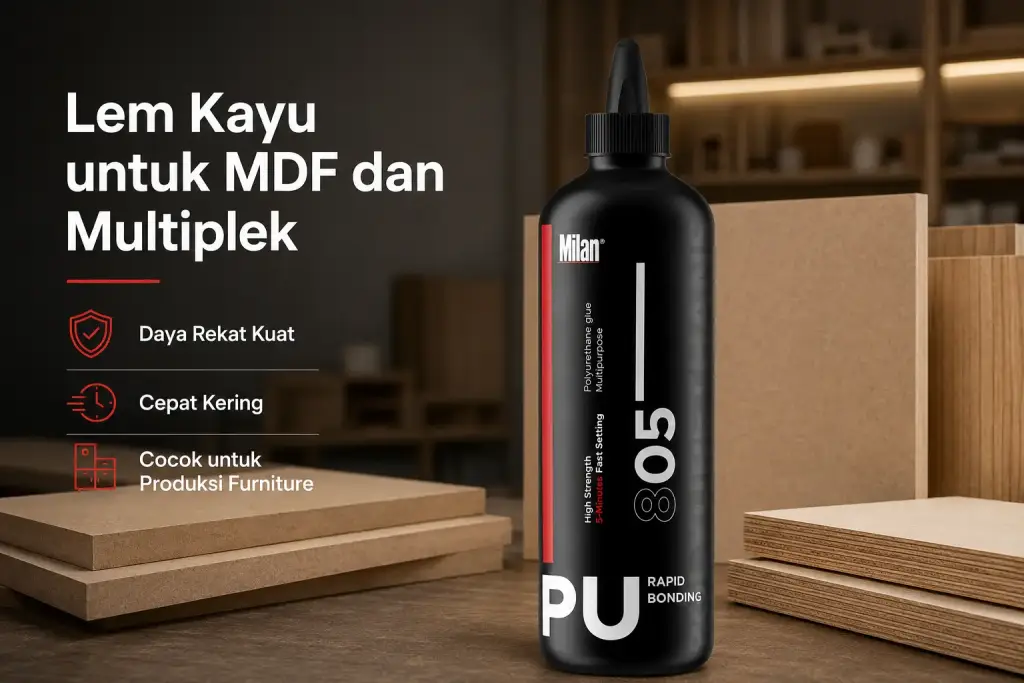
For Milanians who need wood glue for MDF and plywood in their furniture production process, Milan PU 805 offers a combination of adhesive strength and application efficiency.
PU 805 is indeed formulated for a variety of substrates, including MDF and plywood, and offers a number of characteristics that support furniture production needs.
Some of the advantages of Milan PU 805 Adhesive include:
- Dries quickly in about 2–5 minutes
- A single component, making it practical to use
- Extremely strong adhesive strength
- Suitable for MDF and plywood
- Can be used on damp wood
- Waterproof
- Suitable for indoor and outdoor use
- Can be used on various types of materials
- Available in 0.5 kg and 1 kg packages
With a relatively short turnaround time, Milan PU 805 can help speed up the assembly process without compromising the required bonding strength of furniture joints.
So, Which One Is Best Suited for Furniture Production?
The choice of adhesive depends on production needs. PVAc can be a good option for interior furniture and simple joints. Epoxy is more suitable when extra-strong adhesion, gap filling, or bonding different materials is required.
Meanwhile, for Milanians who need an MDF and plywood adhesive that is strong, practical, quick-drying, and suitable for use on a variety of substrates, a polyurethane adhesive such as Milan PU 805 is an attractive option for furniture production.
So, wood glue for MDF and plywood can be further tailored to the needs of the furniture project you’re working on.
Improve the Bond Strength of Furniture Joints with Milan PU 805 Adhesive!
Don’t let the quality of your furniture suffer just because of subpar joints. Use an adhesive that’s specifically designed to provide strong bonding while also making the production process more efficient.
PT Indocipta Wisesa The company has introduced an innovative adhesive that can bond various types of substrates, including MDF and plywood. Not only does it offer strong adhesion, but it also dries quickly—in just 2–5 minutes.
The product is Milan PU 805 Adhesive which meets the ED 204 (B4/D4) requirements. Therefore, its performance is unquestionable for both large- and small-scale furniture production.
Still unsure? Consult with the Milan Experts Team about your Milanians project and ask about the specifications of PU 805 Adhesive by clicking the banner below!