Have you ever encountered wood that’s still damp but needs to be joined right away? This situation is quite common in furniture making, construction, and the production of wood components. The problem is, not all types of glue work well on wood with high moisture content.
So, can wet wood be glued?
The answer is yes, but it depends heavily on the wood’s moisture content and the type of adhesive used. Choosing the right adhesive is important because the moisture content of the wood can affect the drying process and the strength of the joint.
If Milanians are working on a project involving wood, such as furniture, they need to understand the types of adhesives and the proper application guidelines for wood with high moisture content.
Can Wet Wood Be Glued?
Can wet wood be glued? Yes, as long as its moisture content remains within the range that the adhesive can handle.
Therefore, the term “wet wood” should be distinguished from wood that is actually submerged or has a surface completely covered with water.
Wood with high moisture content can still be bonded using certain polyurethane (PU) adhesives. PU adhesives work by utilizing moisture during the curing process, making them suitable for applications involving wood with high moisture content (MC).
For example, Milan PU Adhesive 845 Designed for wood with a moisture content of approximately 18%–40%.
However, this does not mean that all wood glues can be used under these conditions. The choice of adhesive must follow the product’s technical specifications. The higher the moisture content of the wood, the more important it is to use a glue that is specifically designed for damp conditions.
What Happens When You Glue Wood with High Moisture Content
When wood has a high moisture content, the water present within the wood’s structure can affect the adhesive bonding process. For adhesives not designed for humid conditions, adhesion may decrease because the adhesive has difficulty bonding optimally to such surfaces.
In addition, wood can still undergo dimensional changes due to moisture content. Wood that shrinks or expands after the bonding process can put stress on the joint. As a result, a joint that initially appears strong is at risk of cracking or coming apart.
So, Milanians shouldn’t just choose a strong wood glue. Make sure the adhesive is actually suitable for the material’s moisture content and the conditions in which it will be used.
Factors Affecting the Adhesive Strength of Wet Wood When Glued
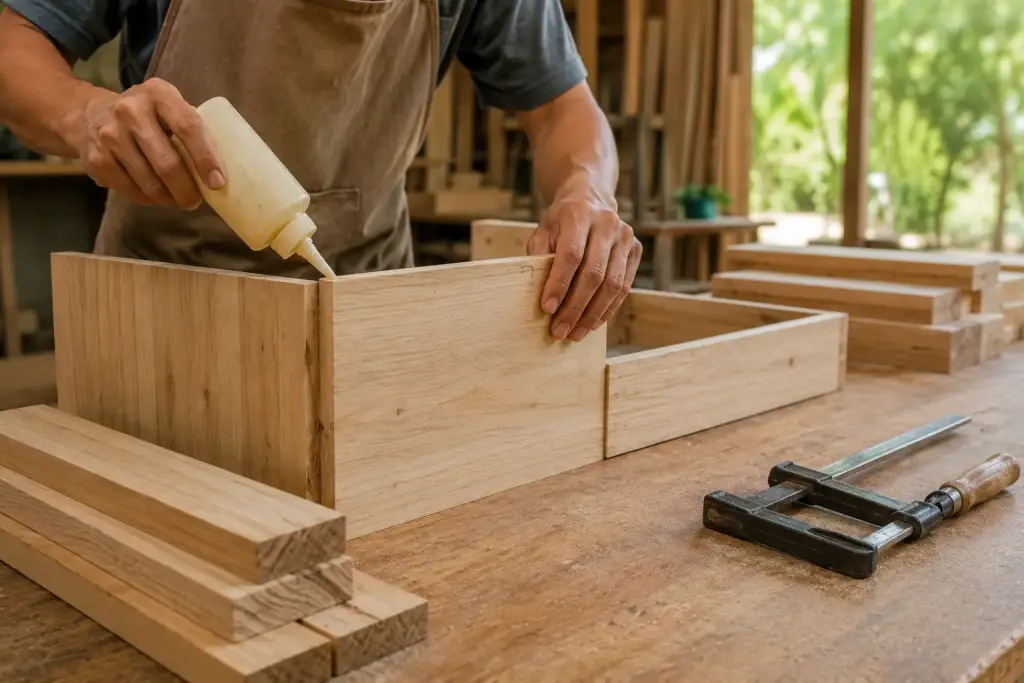
1. Moisture Content in Wood
Moisture content is the most important factor and cannot be overlooked in furniture or interior design projects. Wood with high moisture content requires an adhesive that can perform well in humid conditions.
Don’t rely solely on the term “waterproof adhesive,” because being water-resistant after it dries doesn’t necessarily mean the adhesive can be applied to wood with a high moisture content.
2. Types of Wood Used
Each type of wood has different characteristics, including porosity, density, and moisture absorption.
Wood that is denser or contains certain natural oils may require more thorough surface preparation to ensure that the adhesive bonds properly.
3. Surface Condition: Is It Clean or Still Dusty?
Moist wood must still be clean. Dust, oil, dirt, finishing residue, or other coatings can act as a barrier between the adhesive and the wood surface.
Even adhesives with high bonding strength may not produce an optimal bond if applied to a dirty surface.
4. The Type of Glue Used—You Can’t Just Use Any Old Thing
The type of adhesive is critical to the success of the bond. Certain PU adhesives are designed for wood with high moisture content, while PVA adhesives are generally better suited for wood surfaces that meet specific moisture content specifications. Therefore, always check the technical data and instructions for use before application.
5. Temperature and Drying Time
Ambient temperature and humidity can affect the curing rate of the adhesive. Do not rush to remove the clamps or apply a load to the joint. Curing time may also vary depending on the type of adhesive, temperature, humidity, and the porosity of the material.
See Also: The Importance of a Base Coat for Wood and How to Apply It
What Type of Glue Is Best for Wet Wood?
1. Polyurethane (PU) Adhesive
Polyurethane (PU) adhesive is one of the most suitable options for woodworking projects involving high moisture content, especially products specifically formulated for such conditions. PU adhesive can utilize moisture during the curing process to create a strong bond.
To meet those needs, Milanians may want to consider Milan PU 845 because it has been designed for various types of wood with different moisture content 18%–40%, and is waterproof and meets the requirements of EN 204 (B4/D4).
In addition, there is Milan PU Adhesive X Designed to bond wood with high moisture content above 12%. This product offers strong adhesion, is waterproof, and can be used for laminating as well as professional woodworking projects.
2. Epoxy Adhesive
Epoxy adhesive consists of two components—resin and hardener—which are mixed together before use. This type of adhesive is known for its high bonding strength and can be used on wood as well as various other materials such as iron, aluminum, glass, and ceramics.
Here are the recommendations: Milan Epoxy Adhesive which can be used for wood applications and is resistant to water, solvents, and chemicals. This product also meets the requirements of EN 204 (B4/D4).
However, this does not mean that epoxy is automatically suitable for wood that is still very wet. The surface of the material must be cleaned and prepared according to the application instructions. For wood with high moisture content, use epoxy only if the material’s condition and the product’s specifications are compatible.
3. PVA Wood Glue
PVA glue, or polyvinyl acetate, is widely used in furniture making and for joining wood because it is easy to apply and suitable for a variety of interior applications.
However, PVA generally requires suitable surface conditions in order to form bonds effectively.
For wood with high moisture content, do not apply PVA immediately without checking the product specifications. If the material is too damp, the moisture can interfere with bond formation and result in suboptimal adhesion.
Why Glue Has Trouble Adhering to Wood Surfaces That Are Still Wet
Glue has difficulty bonding when the wood surface contains excess moisture because the adhesive requires specific surface conditions to form an optimal bond.
Excess water can dilute the adhesive or prevent it from bonding to the substrate, depending on the type of formulation.
Problems can also arise after the joint has been glued. Wood that still has a high moisture content is likely to shrink as it dries. These dimensional changes can put stress on the glue line, putting the joint at risk of failure.
That is why the question of whether wet wood can be glued cannot be answered simply with “yes” or “no.”.
The most important factor is whether the wood’s moisture content meets the specifications of the adhesive being used.
See Also: Wood Glue for MDF and Plywood: Which Is Best for Furniture Production?
How to Glue Wet Wood for Strong, Long-Lasting Bonding
1. Make sure the wood has a moisture content that meets the adhesive specifications
Measure the wood’s moisture content using a moisture meter, if available. Do not determine the condition of the wood based solely on touch. For products such as Milan PU 845, wood with a moisture content (MC) of 18%–40% is still within the recommended range.
2. Clean the Surface of Dust, Dirt, and Oil
Clean both surfaces to be bonded. Make sure there is no dust, oil, dirt, or finishing residue that could prevent direct contact between the adhesive and the wood.
3. Apply the Adhesive According to the Technical Instructions
Use the recommended amount of adhesive. Don’t assume that more adhesive means a stronger bond. With PU adhesive, for example, using too much can cause it to expand and ooze out of the joint.
4. Align the Two Wood Surfaces and Press Them Together Using a Clamp
After applying the glue, immediately join the two surfaces together. Use clamps or other fasteners with sufficient pressure to keep the wood surfaces tightly pressed together during the curing process.
5. Wait for the Glue to Dry Completely
Do not apply a load or proceed to the next joint immediately. Curing time can be affected by temperature, humidity, and the porosity of the wood.
For the Milan PU 845 and PU X, the clamp can be removed after about 45–55 minutes, while bonding testing is ideally performed after 12 hours.
6. Remove the clamp, and you can proceed to the next step
Once the adhesive has set sufficiently, the clamp can be removed. Make sure the joint is stable before proceeding with processes such as sanding, finishing, staining, or applying a load.
Recommended Adhesives for Wet Wood with High Moisture Content
1. Milan 845 PU Adhesive
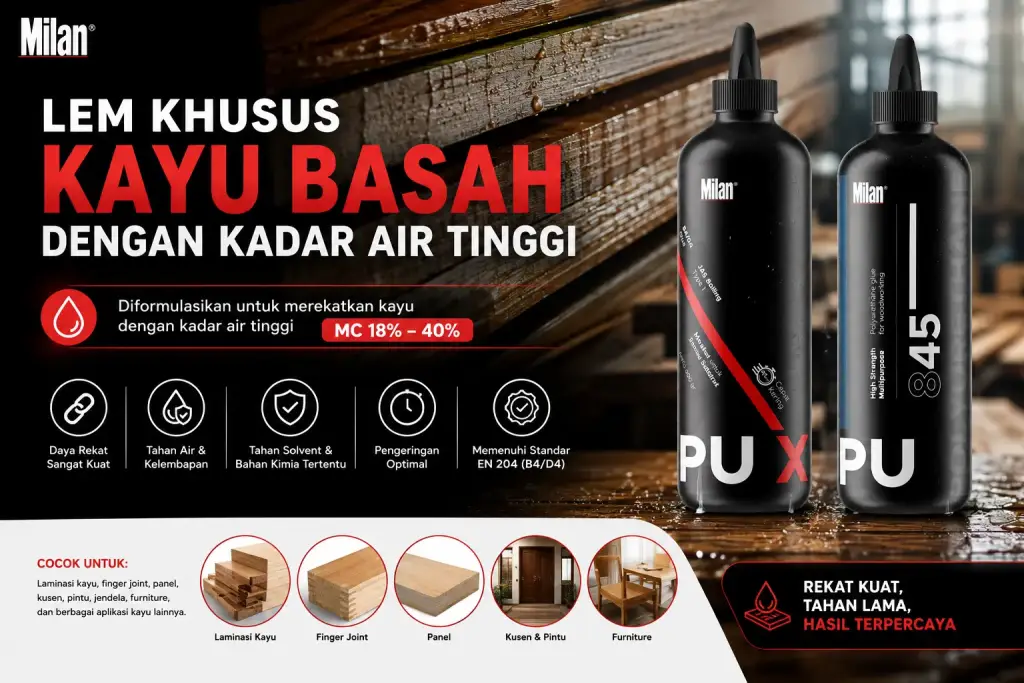
Milan PU Adhesive 845 It is a one-component polyurethane adhesive specifically designed for use on wood with a high moisture content, ranging from approximately 18% to 40%.
The formula provides strong adhesion, is waterproof, and is suitable for a variety of applications, such as wood lamination, finger joints, panels, door frames, doors, windows, and furniture.
For Milanians working with wood that has not yet reached a low moisture content, PU 845 is one of the more suitable options because its specifications are designed for wood with high moisture content.
2. X Milan PU Adhesive
Milan PU Adhesive X This is a polyurethane adhesive designed for bonding wood in high-moisture environments. This product offers strong adhesion, is waterproof, and is resistant to solvents and chemicals; it also meets the requirements of EN 204 (B4/D4).
PU X adhesive is a good choice for furniture makers and professionals who need an adhesive for woodworking projects in conditions with higher humidity than those typically encountered with conventional wood glues.
FAQ (Frequently Asked Questions)
What Is the Ideal Moisture Content of Wood Before Gluing?
There is no one-size-fits-all figure for all adhesives. The ideal moisture content must follow the adhesive’s specifications. For PU adhesives specifically designed for damp wood, such as Milan PU 845, the recommended MC range is 18%–40%.
What Should You Do If the Wood Can’t Be Dried First?
Use an adhesive specifically designed for wood with high moisture content. Do not use conventional wood glue just because the material needs to be processed immediately.
How Long Should Wood Be Dried Before It Is Glued?
The drying time for wood cannot be determined solely by the number of days, as it depends on the type of wood, thickness, environmental conditions, temperature, and humidity. The most accurate method is to measure the moisture content (MC) using a moisture meter.
What’s the Difference Between Glue for Dry Wood and Wet Wood?
The difference lies in the formulation and the application conditions the adhesive can handle. Adhesives for damp wood must be able to work at higher moisture levels, while adhesives for dry wood generally require drier surface conditions.
Is Waterproof Wood Glue Suitable for Wet Wood?
Not necessarily. The “waterproof” label indicates the joint’s resistance to water after the adhesive has cured; it does not mean the adhesive can automatically be applied to wood with high moisture content. Always check the recommended moisture content (MC) specifications.
Want Perfect Bonds on Wet Wood? Use Milan PU Adhesive—Proven to Bond Wood with High Moisture Content!
The answer to the question “Can wet wood be glued?” is yes. However, Milanians should still take other factors into account, such as the moisture content and the type of adhesive used.
If Milanians are working with wood furniture that has a moisture content of 12% or a high moisture content of 18–40%, then Milan PU Adhesive 845 and PU Adhesive X could be an option.
PU Adhesive Milan This product has been specifically designed to bond wet wood with high moisture content. Furthermore, it meets EN (B4/D4) requirements, so there is no doubt about its performance in bonding wood joints.
Well, for Milanians who want their wet wood joints to bond perfectly, don’t hesitate to use Milan PU Adhesive.
If you’re still unsure, Milanians can consult directly with Milan’s team of experts. They’ll provide recommendations on the right adhesive specifications for your project needs.
How do I get in touch? Milanians just need to click the banner below to ask questions directly to the Milan Expert Team!